

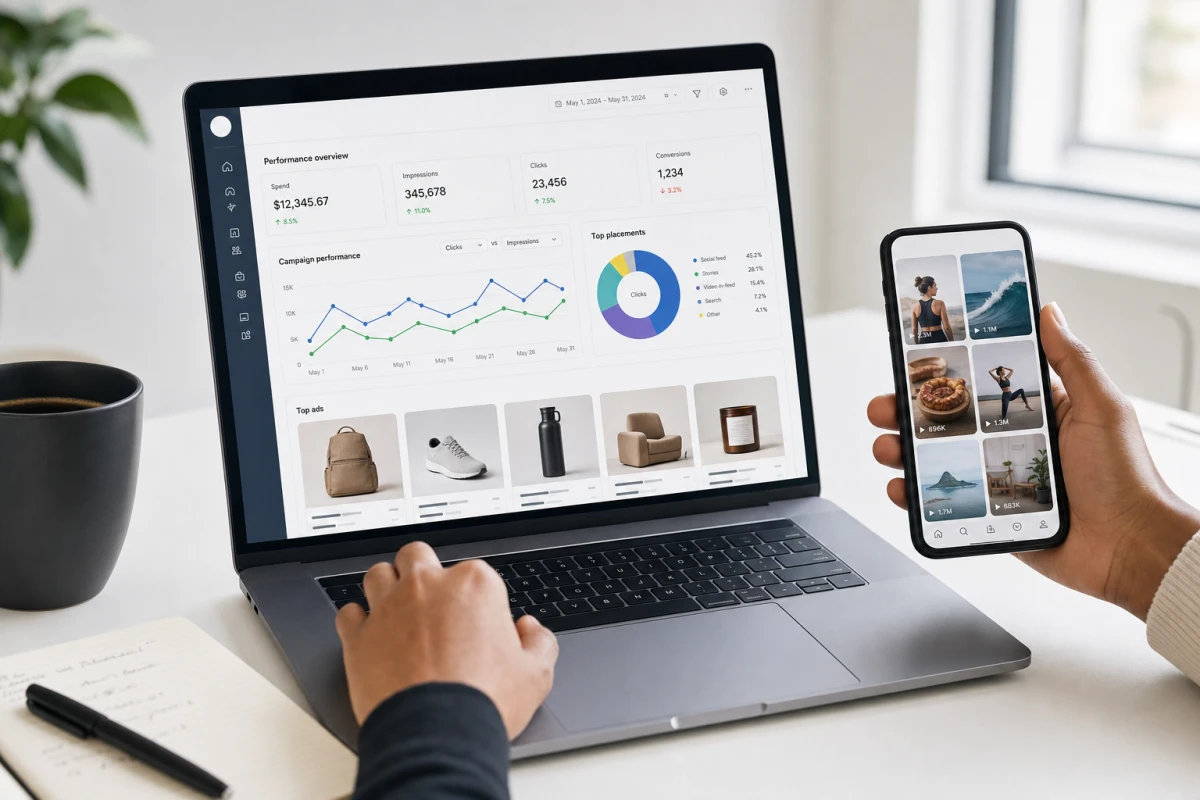
One of the most common challenges for TikTok Shop sellers is getting GMV Max campaigns to perform well from the start. Automated campaigns depend on data to make smart bidding decisions, and without enough initial signals, they tend to underdeliver in the early stages. That gap between launching a shop and having enough data to drive efficient automated results is where many brands lose momentum.
A practical way to close that gap is to run a dedicated Traffic campaign in TikTok Ads Manager specifically designed to generate clicks, video views and product page views. The goal is not immediate conversions. The goal is to feed GMV Max with the data points it needs to optimize effectively. This guide walks through exactly how to do that, from campaign setup to budget expectations and measurement.
Why feed GMV Max with Ads Manager traffic
GMV Max is an automated campaign type that uses machine learning to allocate budget and optimize delivery across TikTok Shop placements. Like any automated system, it performs better when it has meaningful data to learn from. When an account is new or a product is fresh, that data simply does not exist yet. This is often called the cold-start problem, and it affects how quickly automated campaigns can find their footing.
A manual Traffic campaign addresses this directly. Instead of asking the system to optimize for purchases before it has seen any meaningful engagement patterns, you first send a consistent stream of clicks, video views and product page views. These signals tell GMV Max which content resonates, which audiences engage with your product listings and which creative formats drive the most interest.
It is important to understand that data collection and conversion optimization are two different objectives. A Traffic campaign is not a sales campaign. Its value is in the signals it creates, not in the purchases it generates directly. Once GMV Max has accumulated enough quality data points from that traffic push, its automated logic can make sharper decisions about where and how to spend budget to drive actual sales.
One important caveat: this tactic works best when the underlying content is strong. If product listings are weak, thumbnails are unappealing or short-form videos fail to communicate value, feeding more traffic to that content will not fix the problem. Content quality needs to be addressed before expecting GMV Max to convert effectively, regardless of how much data you supply.
Step-by-step: create a Traffic campaign for TikTok Shop
Setting up this campaign inside TikTok Ads Manager is straightforward once you know which options to select. Here is a step-by-step walkthrough of the recommended configuration.
- Create a new campaign. Inside Ads Manager, select Campaign and choose Traffic as the campaign objective. When prompted for optimization type, select Manual optimization. This gives you more control over where clicks are directed.
- Name the campaign clearly. Use a naming convention that identifies the purpose, such as including “Traffic” and the date range or product category. Enable Campaign Budget Optimization (CBO) at the campaign level.
- Set the daily budget. A minimum of $50 per day is a practical starting point for this campaign type. This keeps spend predictable while generating enough volume to accumulate signals.
- Configure the ad group. Under the ad group settings, set the optimization location to TikTok Shop. This ensures that clicks flow directly to your product listings inside TikTok Shop rather than to an external site. Set language to English if you are targeting a US audience.
- Add your ads. Use short-form videos linked to product cards. When possible, connect the video content directly to the product listing it promotes. This improves the relevance of the product page views being generated and makes the data more useful for GMV Max.
Keep the structure simple. One campaign, one or two ad groups with broad targeting, and a handful of creatives is enough to start generating meaningful signals without overcomplicating the account structure.
Budget, timeline and expected metrics
The minimum recommended daily budget for this type of Traffic campaign is $50 per day. That said, the total spend needed to generate useful data for GMV Max depends on your account, niche and creative quality. A consistent spend over several weeks tends to produce better signal accumulation than a large short-term burst.
As an illustrative example, one data collection push run over approximately 30 to 40 days with around $2,000 in total ad spend generated roughly 40,000 clicks to product cards and content, approximately 312,000 video views and around 20,000 product page views. The content-to-product-page-view rate reported in that test was 12.36%. These numbers are shared as an anonymized reference point, not as a benchmark you should expect to replicate exactly. Results vary based on content quality, product category, audience and market conditions.
A reasonable testing window for this type of campaign is two to six weeks. That timeline gives the algorithm enough cycles to gather diverse signals across different days, times and audience segments. Shorter runs can still provide useful data, but a longer consistent push typically produces a richer signal set for GMV Max to learn from.
The primary metrics to watch during this phase are clicks, video views, product page views and the content-to-product-page-view rate. These are your indicators of content engagement and audience interest, not conversion metrics. If product page views are low relative to video views, that often signals a content gap between the video and the product listing itself.
Audience strategy: open audiences and broad targeting
For the purpose of feeding GMV Max with data, broad targeting is almost always the right starting point. An open audience, meaning one with minimal demographic filters and no interest or behavior restrictions, allows TikTok’s algorithm to explore a wide range of users and discover which segments actually engage with your content and product listings.
Narrow targeting limits that exploration. When you restrict targeting to a tight interest category or a small demographic slice, you reduce the diversity of signals entering your account. GMV Max benefits from seeing how different audience types respond to your content, and open targeting gives the system the room it needs to find those patterns organically.
If your account has very little prior traffic and no historical data at all, adding one broad interest or behavior category can help the algorithm find an initial user base to start with. Think of it as a light seed, not a filter. Once the campaign starts generating data, you can let the open audience take over and remove that seed if the system is performing well on its own.
For US-based brands, make sure to set the language filter to English within the ad group. This simple step ensures your ads are shown to users who can actually engage with English-language content, which keeps the data points relevant and avoids diluting your signals with traffic that will not convert.
How to measure results and iterate to improve GMV Max
During the data collection phase, your primary KPIs are clicks, video views, product page views and the content-to-product-page-view rate. These tell you which creatives are driving genuine interest and which ones are generating views without pulling users deeper into your TikTok Shop.
Use these signals to identify your top-performing videos. If a specific piece of content is generating a significantly higher product page view rate than others, that is a strong indicator that it communicates your product’s value clearly. Those are the assets worth scaling. Once you have accumulated enough signal from the Traffic campaign, move your best-performing videos into GMV Max as primary creative assets. The automated system will then have both the data and the content quality it needs to optimize for conversions.
Knowing when to pause or adjust the campaign is just as important as knowing how to set it up. If video views are strong but product page views remain consistently low, the issue is likely a disconnect between the content and the product listing. In that case, pause the campaign, update the creative or improve the product listing, and restart the push. Continuing to spend on traffic that does not reach the product page only generates noise in your data.
When automated GMV Max campaigns start showing stronger results after the data push, begin shifting more budget toward them and reduce the Traffic campaign spend gradually. Monitor the GMV Max return on ad spend as it stabilizes and use creative testing on an ongoing basis to keep feeding fresh signals. The Traffic campaign can be run again periodically whenever you introduce new products, refresh creatives or see GMV Max performance plateau.
Conclusion
Using a manual Traffic campaign in TikTok Ads Manager to supply GMV Max with clicks, video views and product page views is a practical and structured way to solve the cold-start problem that affects most new TikTok Shop accounts. Rather than expecting automated campaigns to optimize immediately without data, this approach creates the conditions for GMV Max to learn and deliver better results over time.
The core takeaway is straightforward: set a Traffic campaign to manual optimization, point it at TikTok Shop, use broad targeting, maintain a consistent daily budget, and let the data accumulate over two to six weeks. Monitor your content-to-product-page-view rate to identify which short-form video assets deserve to move into GMV Max. Campaign optimization is a continuous process, and the quality of the signals you supply directly influences how well your automated TikTok Shop ads perform at scale.
For ecommerce brands focused on product discovery and growth through social commerce, this tactic fits inside a broader TikTok Shop strategy that connects content management, campaign structure and ongoing performance analysis. RGC Mkt works with TikTok Shop sellers on services that span Initial TikTok Shop Setup, TikTok Ads Management, Campaign Optimization and Content Management. If you want a clearer picture of how your current setup could be improved, reach out to the RGC Mkt team to schedule a consultation or account audit.