

TikTok Shop has permanently moved past its early days of rapid, unmonitored growth and entered a highly structured, enterprise-grade phase where regulatory rules are strict, algorithm enforcement is automated, and the operational stakes are higher than ever. For brand managers, agency directors, and creator network leads, this maturity changes nearly every element of the social commerce playbook: how you recruit creator cohorts, what messaging boundaries you enforce, and how you measure return on capital at the individual creator level.
The brands that continue to scale Gross Merchandise Value (GMV) consistently across quarters share an operational common thread. They treat creator portfolio management as a rigorous logistics discipline rather than a casual marketing tactic. They pair short-form content creativity with uncompromising compliance engineering, and they track performance metrics at the individual creator and SKU level rather than relying on high-level campaign averages. This comprehensive guide breaks down each layer of that operational approach so you can apply it to your own TikTok Shop program.
How TikTok Shop Has Evolved: From Wild West to Regulated Marketplace
In the initial rollout phase of TikTok Shop, the market aggressively rewarded speed, volume, and unvetted claims. Creators and account managers who executed fast, tested bold product efficacy claims, and saturated the feed with high video volume generated rapid GMV before platform moderation systems caught up. That window has definitively closed. Marketplace policy enforcement has intensified across all major operating regions, violation strikes are issued automatically, and account bans have increased significantly across the ecosystem.
This enforcement evolution is a structural necessity. As TikTok Shop cements its position as a primary global e-commerce channel, the platform has a fundamental incentive to protect consumer trust, credit card processing relationships, and regulatory standing. Misleading product claims, unsupported health or transformation statements, unauthorized price claims, and policy-skirting content now trigger automated machine-learning flags and manual human reviews at a vastly higher frequency than at launch. Some brand shops have faced temporary product listing freezes; others have suffered permanent account terminations.
The conversion path follows three seamless steps:
- Early Phase (Unchecked Growth): Relying on high claims and unvetted content leads to fragile GMV spikes paired with severe account risk.
- Mature Phase (Regulated System): Enforcing strict compliance rules across tiered creator cohorts produces predictable, compounding GMV.
For brands and agency teams, this shift means opportunistic growth hacks no longer scale. Building a revenue model on exaggerated product claims creates an inherently fragile operation that can be shut down overnight. The brands compounding GMV today build on reproducible, enterprise-ready systems: structured creator onboarding pipelines, content workflows that remain within strict policy boundaries, and supply chain operations designed to pass rigorous platform audits.
This platform maturity is a net positive for professional operators. A regulated marketplace eliminates low-quality, bad-actor competition, rewards transparent product positioning, and creates a level playing field for brands willing to invest in sustainable operational infrastructure from day one.
Building and Managing Creator Portfolios for Compounding GMV Growth
Creator networks represent the core engine behind scalable TikTok Shop revenue. Managing a network of 1,500 to 2,000 active affiliate creators—organized precisely by content niche and performance tier—is standard practice among mature social commerce agencies. However, structure matters far more than raw account numbers. A creator pool without clear performance tiers, standardized onboarding systems, and aligned Key Performance Indicators (KPIs) will produce volatile, unpredictable sales regardless of overall roster size.
Recruitment must be systematic rather than reactive. Brand managers should target creators whose audience demographics align directly with the product’s primary buyer persona, whose visual style fits native short-form formats, and who hold a documented track record of driving purchasing action rather than vanity view counts. Once onboarded, every creator must pass through a standardized briefing system that aligns them on approved health and product claims, pricing accuracy, brand voice, and strict platform compliance rules. Skipping structured onboarding is the single most common cause of account-level policy violations downstream.
Creator Portfolio Tiering & Governance Matrix
| Creator Tier | Roster Volume % | Typical Audience Size | Primary Agreement Model | Primary Operational Focus |
|---|---|---|---|---|
| Tier 1: High-Volume Micro-Affiliates | 70% – 80% | 1,000 – 25,000 followers | Pure performance affiliate (Targeted Deals) | Broad baseline coverage, organic search footprint, and hook testing. |
| Tier 2: Mid-Tier Performers | 15% – 20% | 25,000 – 150,000 followers | Graduated commission + sample priority | Consistent monthly GMV volume, high-quality visual demos, and Spark Ad sourcing. |
| Tier 3: Hero Creators & Brand Partners | 5% | 150,000+ followers | Hybrid (Base fee + performance bonus) | High-impact product launches, dedicated live shopping events, and brand equity. |
Commission models must be engineered to incentivize top-tier output while protecting gross product margins. Performance-based affiliate commissions tied strictly to tracked in-app sales represent the most scalable model for Tier 1 micro-creators. As creators demonstrate consistent conversion ability, brands can deploy graduated commission tiers, exclusive product sample access, or hybrid agreements (combining a baseline fee with performance commissions) to retain top-performing talent and secure content exclusivity.
Operations at this scale require robust tracking infrastructure. Custom affiliate link management, real-time GMV tracking dashboards by creator, and weekly content review cadences are non-negotiable. Without granular data visibility at the individual creator level, brand managers cannot identify which creators drive profitable conversions, which require messaging guidance, and where budget efficiency is leaking.
Compliance Engineering, Violation Prevention, and Account Protection
Compliance can no longer be treated as a passive back-office check; it must be engineered into the very beginning of the content creation process. The most frequent causes of listing suspensions and account strikes on TikTok Shop involve misleading product efficacy claims, unsubstantiated health or medical claims, absolute outcome guarantees, unauthorized comparison claims, and improper affiliate relationship disclosures. Every single one of these friction points is completely preventable with a structured review framework.
Pre-Publish Content Compliance Checklist
- Substantiated Claims: Is every performance, material, or efficacy claim backed by documented, verifiable testing or approved brand documentation?
- No Absolute Guarantees: Does the script avoid promising guaranteed visual, financial, or personal outcomes (e.g., “Guaranteed to work in 3 days”)?
- Price & SKU Alignment: Does the price, discount, or promotional deal mentioned in the audio or text match the active product listing in TikTok Shop exactly?
- Prominent Affiliation Disclosure: Is the commercial relationship clearly disclosed via native platform disclosure tags or unambiguous text overlays (e.g.,
#ad,#affiliate)? - Category-Specific Policy Check: Does the product category require specific regulatory disclaimers (e.g., cosmetics, dietary supplements, electronics) that are correctly displayed?
- Manager Sign-Off: Has the video asset been reviewed and logged by an internal brand compliance lead prior to publishing?
When policy violations do occur, the operational escalation protocol dictates how fast the account recovers. Brand teams must immediately log the violation notice, analyze the specific timestamp and audio/visual element that triggered the strike, update internal briefing documentation, and remove non-compliant content assets from distribution channels.
For account-level warnings, brand managers must utilize the official platform appeals portal, submitting factual, evidence-backed documentation rather than emotional appeals. For complex escalation scenarios involving repeated automated strikes or severe account risk, retaining legal counsel or specialized compliance consultants familiar with platform policy guidelines is a necessary operational investment.
The ultimate protection against account strikes is cultural rather than purely procedural. Creator networks where account managers train creators to default to truthful, evidence-backed product demonstrations will consistently outperform networks that treat compliance as an afterthought applied right before posting.
The Modern Content Framework: What Converts in a Mature Marketplace
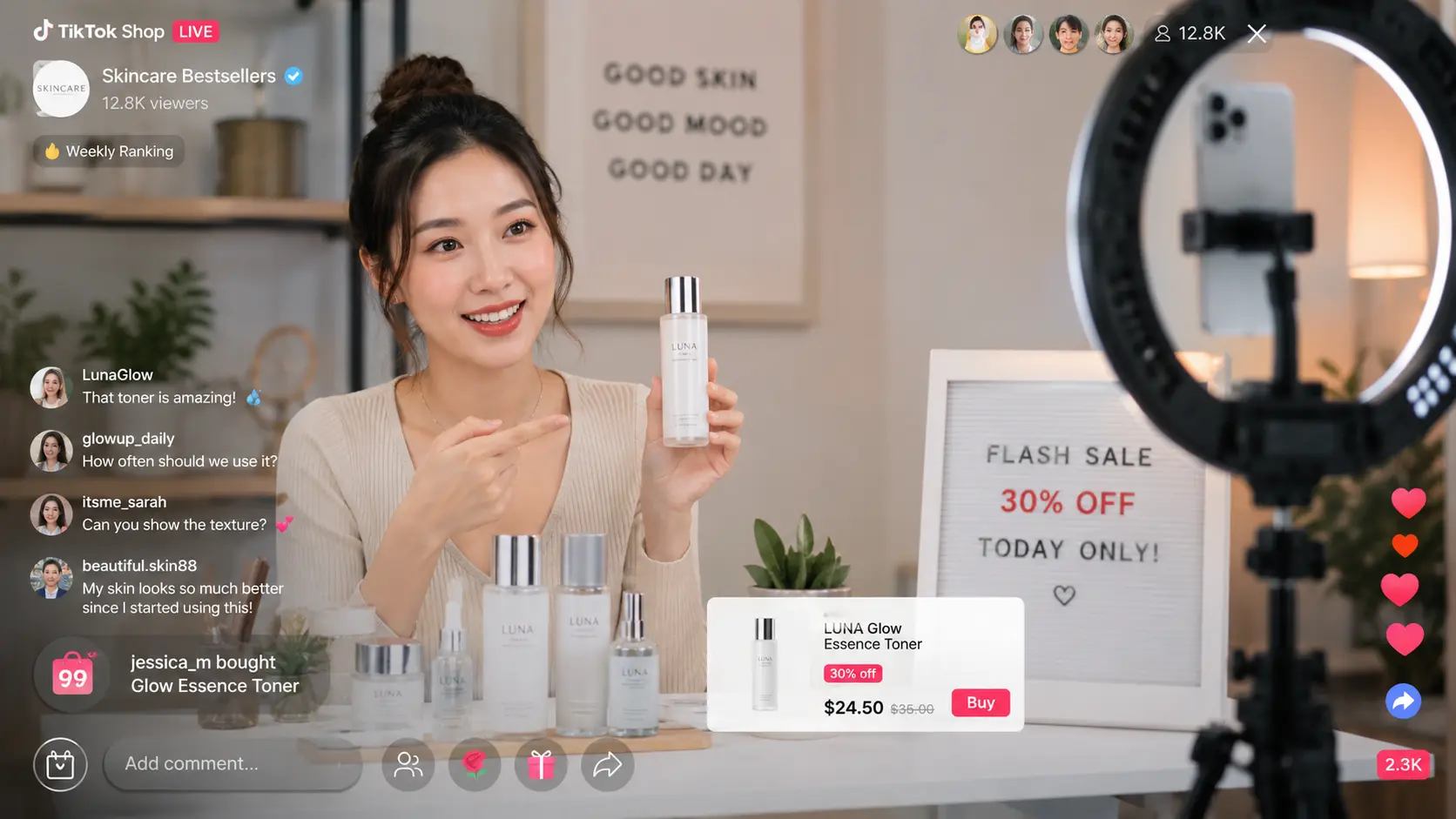
The short-form video assets that consistently drive conversions on TikTok Shop share a precise visual and structural architecture: they command audience attention within the first three seconds, demonstrate product utility in an authentic environment, and provide a frictionless call-to-action that guides the viewer to the native shopping cart.
The video hook is the single most critical variable. If the first 3 seconds fail to establish a visual trigger, highlight a relatable daily frustration, or generate intense curiosity, the remainder of the video will fail to convert—regardless of how superior the underlying product or offer may be.
The 30-second conversion architecture breaks down into four essential stages:
- The Visual & Curiosity Hook (0–3s): Stop the scroll instantly with a visual trigger, bold problem statement, or curiosity gap.
- The Problem & Solution Demo (3–15s): Show the product actively solving the pain point in an authentic, unscripted setting.
- Social Proof & Context (15–22s): Provide quick visual validation via real customer quotes, unboxing reactions, or practical comparisons.
- The Native Call-to-Action (22–30s): Direct the viewer’s focus clearly to the native shopping bag tag.
High-Converting Video Formats
- Real-Time Problem/Solution Demos: Unscripted, high-clarity demonstrations showing the product solving an immediate, visible problem in a realistic home or workplace setting.
- Authentic How-To & Utility Content: Step-by-step instructional content that highlights product functionality, unique features, and ease of use.
- Verified Social Proof & UGC Aggregation: Featuring authentic customer reviews, unboxing reactions, and real-world usage footage that validates product claims visually.
- Compliant Before-and-After Comparisons: Allowed strictly within approved categories (e.g., non-medical styling, home cleaning), provided the visual results are realistic, typical, and explicitly declared non-guaranteed.
Creative testing must be executed as an engineered system rather than a series of random guesses. A proven agency testing model involves producing 8 to 10 distinct creative hook and angle variations for a single SKU, monitoring real-time conversion and view-through metrics across the first 7 days, and then applying paid ad spend (such as Spark Ads) behind the top 2 or 3 performing organic assets. This data-driven approach eliminates wasted ad spend and creates a continuous feedback loop that elevates content quality across the entire creator network.
Paid TikTok Ads and organic creator content must operate as a unified growth engine. Utilizing Spark Ads to boost top-performing organic creator posts preserves the authentic user-generated feel of the content while granting the brand precise demographic targeting and distribution power.
Performance Analytics, Strategic Partnerships, and LTV Optimization
Scaling TikTok Shop revenue on a multi-quarter horizon requires tracking data at a granular operational level. High-level GMV totals provide summary reporting, but they obscure which specific creators, creative hooks, and SKUs are driving profit versus burning cash. The operational KPIs that demand daily tracking include individual creator conversion rates, creator-specific Cost Per Acquisition (CPA), Return on Ad Spend (ROAS) on boosted posts, Average Order Value (AOV), and 30-to-90-day repeat purchase rates.
The Three Core Creator Partnership Frameworks
- Pure Performance Affiliate Model: The creator receives a baseline percentage commission on verified in-app sales driven through their tag. This model carries zero fixed financial risk for the brand, making it ideal for Tier 1 micro-creator testing.
- Guaranteed Content Sponsorship Model: The brand pays a fixed flat fee for guaranteed video assets and publishing commitments. This model is reserved for high-reach Tier 3 creators with proven audience alignment and historical conversion proof.
- Hybrid Performance Model: The brand provides a modest base fee to cover production costs paired with a performance commission tier. This structure balances creator financial security with brand incentive alignment, making it the preferred model for Tier 2 mid-tier creators.
Product detail page optimization remains a frequently neglected revenue lever. Even when high-converting creator content drives massive traffic to the shop, an unoptimized listing—characterized by weak gallery images, generic bullet points, poor review velocity, or uncompetitive pricing—will severely suppress checkout conversion. Listings must undergo continuous testing: updating main images, refining benefit-driven titles, maintaining inventory buffers during campaign spikes, and ensuring listing pricing matches creator messaging precisely.
To maximize customer Lifetime Value (LTV) and absorb rising ad acquisition costs, brands must activate backend monetization levers within TikTok Shop:
- Strategic Multi-BUY Bundling: Designing multi-item or bulk bundles directly within the listing catalog to raise baseline Average Order Value (AOV).
- Cross-Sell Product Sequences: Utilizing post-purchase automated communications and retargeting ads to introduce complementary SKUs to previous buyers.
- Ad-to-Shop Retargeting Funnels: Deploying custom ad campaigns targeting users who engaged with organic creator videos or added items to their cart without completing checkout.
Conclusion
Scaling a brand on TikTok Shop in today’s social commerce environment is a disciplined operational challenge that requires specialized systems. The platform’s market maturity means that winning brands are those that invest in formal creator portfolio management, enforce strict compliance protocols, execute structured creative testing, and evaluate performance data at the individual creator and SKU level. Each element reinforces the others: robust compliance protects the creator network, high-converting content drives conversion metrics, and granular analytics inform smarter media allocation.
For brand leaders and e-commerce executives competing in the social commerce sector, adopting this operational framework is essential. The era of casual, unstructured social selling has ended. The market now aggressively rewards operational discipline, transparent product positioning, and data-driven execution. Brands that build these structural foundations today will compound market share and net profitability at a rate that late adopters will struggle to match.
RGC Mkt specializes in full-funnel TikTok Shop management and social commerce growth execution for brands. From initial shop configuration, catalog optimization, and compliance engineering to TikTok Ads management, creator portfolio outreach, and multi-channel campaign planning, RGC Mkt delivers the technical infrastructure and strategic execution required to scale predictably. Reach out to the RGC Mkt team today to evaluate your current setup and launch your next growth phase.