


TikTok Shop has moved far beyond a social media experiment. In roughly two years, the platform grew from approximately 4,500 US sellers to more than 231,000, recording an estimated $33 billion in sales in a single year. That kind of growth signals a structural shift in how consumers discover and buy products, not a trend that ecommerce brands can afford to sit out.
What makes TikTok Shop different from a standard marketplace is the way it collapses the traditional funnel. Discovery, consideration, and purchase all happen in one place, without ever sending the shopper somewhere else. For brands already selling on Shopify or Amazon, the platform also delivers something unexpected: a measurable lift on those existing channels. Understanding why that happens, and how to take advantage of it, is what this article is about.
How TikTok Shop Works: Content In, Sales Out
TikTok Shop functions as an on-platform storefront embedded directly inside the TikTok app. Brands list products, creators promote them through short-form video and live streams, and shoppers complete the entire purchase without leaving the app. The result is a content-driven commerce loop where entertainment and buying intent exist on the same screen.
The contrast with traditional ecommerce funnels is significant. A standard paid ad flow requires a user to click an ad, land on an external website, navigate a product page, and complete checkout. Each step introduces friction and drops off potential buyers.
| Funnel Stage | Traditional External Ad Flow | Native TikTok Shop Flow |
|---|---|---|
| Discovery | Standard ad placement in feed | Organic or sponsored creator video |
| Navigation | External redirect to website (adds load delay) | Instant native product overlay tag |
| Consideration | Browse product page and off-site reviews | In-video social proof and live product demos |
| Checkout | Manual form entry or third-party wallet | 1-tap saved native in-app checkout |
| Conversion Impact | Baseline web conversion | ~3x Higher Native Conversion Rate |
That friction reduction has a measurable impact on conversion rates. Reported data from brands operating on TikTok Shop shows approximately three times more checkout conversion on native in-app purchases compared to off-platform flows. When a user can tap a product tag in a video and complete payment in a few seconds, the gap between interest and purchase shrinks dramatically.
Five Ways Brands Can Sell on TikTok Shop
TikTok Shop is not a single-channel play. Brands that scale effectively typically combine two or more of the following methods to build consistent revenue and reach different segments of the platform’s audience:
- Affiliate and creator partnerships: Creators promote products to their organic audiences and earn a commission on every sale they generate. This is consistently one of the highest-volume revenue sources for brands on TikTok Shop, especially when multiple creators are activated simultaneously.
- Organic shop listings: Brands publish product listings discoverable through TikTok’s in-app shopping search and browsing features. Well-optimized listings with strong visuals and clear descriptions capture demand from users actively looking to buy.
- Paid TikTok Shop ads: Sponsored placements amplify reach beyond a brand’s existing followers. Paid advertising on TikTok Shop can be targeted by audience interest, behavior, and purchase intent, making it effective for scaling products that are already converting organically.
- Live shopping: Brands or creators host live streams where products are demonstrated and sold in real time. Live shopping tends to drive strong add-to-cart and checkout rates because it creates urgency and allows real-time Q&A.
- Integrated storefront with paid campaigns: The most advanced approach combines an optimized product listing catalog with paid Spark Ads amplifying creator content, creating a flywheel where organic and paid reinforce each other.
For brands testing the platform for the first time, starting with a focused affiliate creator program alongside one paid campaign on a single high-margin SKU is a practical way to validate demand before scaling investment.
The Halo Effect: How TikTok Shop Boosts Shopify and Amazon Revenue
One of the more counterintuitive findings from brands entering TikTok Shop is what happens to their other revenue channels. Brands have reported Shopify and Amazon revenue lifts of roughly 20 to 30 percent on top of their TikTok Shop sales after activating the platform. This is what practitioners call the halo effect, and understanding the mechanics behind it explains why the lift is real rather than coincidental.
Core Strategic Insight: TikTok Shop created the demand; a different channel captured the transaction. Millions of users discover a product through TikTok’s algorithm, but choose to complete their purchase on Amazon or Shopify because they prefer a familiar checkout or want to read external reviews.
There is also a customer acquisition cost benefit. When creators and organic content generate awareness at low incremental cost, the effective cost of acquiring a customer across all channels decreases. That efficiency can show up as better return on ad spend on existing Amazon Sponsored Products campaigns or higher organic conversion rates on Shopify, simply because more buyers already recognize the brand.
To measure this effect accurately, set a clean baseline. Track Shopify and Amazon revenue for 30 days before launching on TikTok Shop, then compare the same metrics after 60 to 90 days of active TikTok Shop operations. Incrementality testing and attribution window analysis can help separate organic lift from coincidental seasonal factors. Present the 20 to 30 percent figure as a reported outcome in comparable cases rather than a guaranteed result for every brand and product category.
Native Checkout, Creators, and Conversion: Why It’s So Efficient
The three-times native checkout conversion advantage is not accidental. It comes from eliminating the moment of hesitation that occurs when a shopper is redirected to an external website. On TikTok Shop, the product, the social proof from the creator’s video, and the buy button are all visible at the same time. The decision to purchase is made in the same context as the discovery, which is fundamentally different from any off-platform flow.
Commissioned creators amplify this dynamic at scale. Instead of a brand running a single ad, dozens of creators can be generating content simultaneously, each reaching their own audience organically. Because creators earn a performance-based commission tied directly to sales, their incentive is to produce content that actually converts rather than content that just gets views. That alignment between creator incentive and brand outcome is a structural advantage over traditional influencer sponsorships.
Structuring creator partnerships for consistent results requires clear briefs. Keeping briefs concise but specific helps creators produce content that converts without over-scripting their natural style, which tends to perform better on TikTok’s algorithm.
Practical Creator Brief Framework
(Example Scenario: Highlighting a $42 daily hydrating facial serum)
- Primary Product Benefit: Deep 24-hour hydration and instant skin barrier repair.
- Target Customer Problem: Dry, dull winter skin that causes foundation to look cakey.
- Suggested Content Format: Quick morning “Get Ready With Me” (GRWM) routine showing texture application close-up.
- Specific Call to Action: “Tap the yellow shopping bag below to lock in the affiliate flash discount before stock runs out.”
- Compliance Requirements: Must clearly tag content as an affiliate partnership and avoid unverified medical claims.
On commission structure, industry-standard approaches typically tie creator earnings to a percentage of the revenue they generate. The exact rate varies by category and margin, but the model scales naturally: a creator who generates more sales earns more, which motivates continued promotion without additional fixed spend from the brand.
First Steps and Practical Tactics to Launch and Scale on TikTok Shop
Getting started on TikTok Shop requires foundational setup before any campaign goes live. A clean shop configuration, compliant product listings, and a clear understanding of the platform’s seller policies prevent early mistakes that can slow growth or trigger account issues.
A practical launch sequence for new TikTok Shop sellers follows six essential steps:
- Account Setup & Documentation: Complete TikTok Shop seller account setup and verify required business documentation.
- Listing Optimization: Publish product listings with high-quality visuals, keyword-optimized titles, and clear descriptions.
- Policy Compliance Check: Review TikTok’s specific product listing policies for your category before publishing.
- Affiliate Creator Activation: Identify and outreach to two to three affiliate creators who closely align with your product and target demographic.
- Brief & Link Preparation: Prepare a structured creator brief detailing product features, primary messaging hooks, and affiliate link placement instructions.
- Conversion Tracking Setup: Implement robust conversion tracking to attribute sales accurately across TikTok and external channels like Shopify and Amazon.
For the first 30 days, focus on a single high-margin SKU. Run one paid campaign targeting a relevant audience segment while two to three creators post organic content with affiliate links. Track daily sales volume, add-to-cart rates, and checkout conversion inside TikTok Shop, alongside any movement in Shopify or Amazon baseline revenue. This controlled test generates real performance data without overextending budget.
After week one, review creative performance and pricing. If a creator’s content is generating views but not sales, assess whether the product page is the bottleneck or the content’s call to action. Optimize the listing, adjust the creator brief if needed, and consider a Spark Ad to amplify the best-performing organic video. Iteration speed in the first 30 days matters more than perfection at launch.
Conclusion
TikTok Shop operates as a fully integrated on-platform storefront where short-form content, creator-driven promotion, and native checkout combine into a high-converting sales funnel. The platform’s reported three-times native checkout conversion advantage reflects a fundamental reduction in purchase friction, and its affiliate creator model aligns incentives in a way that scales organic reach without proportional increases in fixed ad spend.
The halo effect is perhaps the most compelling strategic argument for product-based ecommerce brands still on the fence. Brands that have adopted TikTok Shop have reported 20 to 30 percent lifts in Shopify and Amazon revenue alongside their in-app sales, driven by the awareness and customer acquisition efficiency that the platform generates. For brands already investing in social commerce, TikTok Shop does not replace existing channels; it amplifies them.
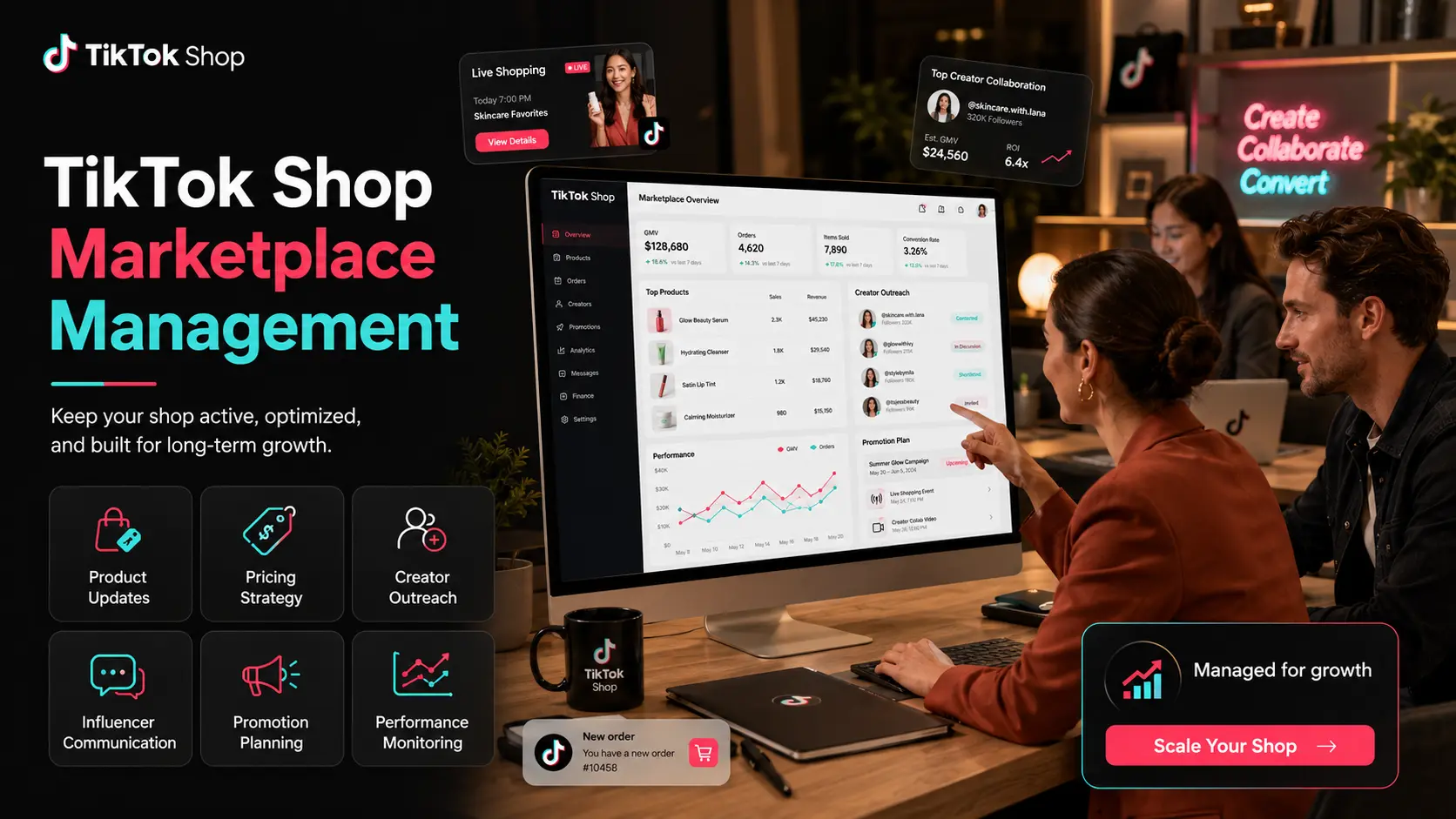
RGC Mkt works with ecommerce brands and retailers in the TikTok Shop and social commerce segment, covering services that include Initial TikTok Shop Setup, product listing optimization, Creator and Influencer Outreach, TikTok Ads Management and Campaign Planning. If you are ready to explore how TikTok Shop setup and a structured creator partnership strategy can lift your existing revenue channels, reach out to the RGC Mkt team to get started.