


Scaling a TikTok Shop brand is not a sprint driven by fleeting viral spikes. It follows a structured, multi-phase growth curve that rewards operators willing to invest in presence, content volume, and platform signals before chasing aggressive net profitability. Understanding this growth trajectory—and engineering operational logistics around it—is what separates brands that stall out at month two from those that achieve predictable, compounding Gross Merchandise Value (GMV) by month six and beyond.
This operational playbook details the complete scaling arc: moving from the initial cold start window through structured growth and into advanced paid amplification tactics. Each section details the financial frameworks, content decisions, paid media mechanics, and inventory controls required to advance from one growth stage to the next with clarity and capital control.
1. The Cold Start Window: Months 1–3 and Signal Engineering
The cold start phase represents the initial 30 to 90 days when TikTok Shop’s machine-learning algorithm indexes your product catalog, analyzes user engagement, and identifies your primary buyer persona. During this foundational window, the primary operational objective is not immediate top-line margin maximization—it is signal density.
The scaling arc moves through three operational phases:
- Cold Start (Months 1–3): Focuses on view-throughs, click-through rates, and baseline conversion signals (prioritizing presence and platform indexing over immediate net profit).
- Growth Phase (Months 3–6): Focuses on creative format diversification, staged Spark Ads amplification, and backend logistics validation.
- Scale Phase (Months 6+): Focuses on product-level GMV Max campaigns, live shopping events, retail halo multipliers, and LTV optimization.
Building signal requires driving high video view-through rates, product link clicks, and baseline checkout conversions so the algorithm understands who your product is for and how to route organic feed traffic efficiently.
Understanding Discovery-Driven Mechanics
TikTok Shop is a discovery-driven social marketplace, fundamentally distinct from intent-driven search channels like Amazon or Google. A consumer viewing a creator’s short-form video may have had zero awareness of your brand ten seconds prior to purchasing. Consequently, your product value proposition must be visually obvious within three seconds, your offer structure must trigger impulse buying intent, and your checkout path must remain completely native inside the app. Complexity at any point in the funnel destroys conversion rates.
Prior performance data from channels like Meta or Google Search provides valuable baseline insights. Understanding which visual hooks, pain points, and customer demographics respond on legacy ad channels gives your TikTok strategy an immediate operational head start, eliminating the need to solve product-market fit from scratch on a new platform.
Cold Start Key Performance Indicators (KPIs)
- Primary Metrics: Visual View-Through Rate (VTR at 3s and 6s), Product Link Click-Through Rate (CTR > 1.5%–3%), and Total Conversion Volume.
- Secondary Metrics: Target ROAS and immediate net profit margins (evaluated as secondary optimization metrics during initial signal gathering).
- Execution Rule: Test a minimum of 10 to 15 unique creator assets during the first 60 days to build sufficient algorithmic signal before evaluating channel performance.
2. The Growth Phase: Months 3–6 and Repeatable Signals
By month three, brands that maintain consistent creator content volume and clear offer structures begin observing repeatable conversion patterns across multiple creators and video angles. This consistency serves as the explicit operational signal that your store is ready to transition from cold start testing to a structured growth program. Repeatable sales driven by a diverse pool of creators—rather than a single isolated viral video—confirm that the platform has indexed your ideal buyer demographic.
During the growth phase, operators accelerate creative volume, diversify creator tiers, and introduce controlled paid media amplification. Rather than scaling cold paid ad spend immediately, deploy small testing budgets via Spark Ads to amplify organic creator videos that have already demonstrated positive conversion signals.
The paid amplification pipeline relies on three clear steps:
- Organic Signal Validation: Identify organic creator videos driving above-average view-through and link click-through rates.
- Authorization Licensing: Obtain Spark Ads authorization codes directly from high-converting creator partners.
- Staged Paid Amplification: Scale ad spend incrementally (10%–20% week-over-week) behind validated organic creative assets.
An organic video that converts cold traffic naturally will almost always outperform a standalone ad creative produced strictly for paid ad accounts.
Managing Creative Fatigue and Operational Load
Creative fatigue occurs rapidly on TikTok feeds. If a brand relies on a single video demo format for 60 consecutive days, conversion metrics will eventually decay as feed saturation sets in. Operators must proactively introduce new visual formats:
- Unboxing & First Impressions: Highlights packaging quality, physical unboxing excitement, and initial product reactions.
- Direct Problem/Solution Demos: Demonstrates real-world utility in a fast-paced, unscripted setting.
- Verified Social Proof & UGC Reviews: Showcases authentic customer testimonials, review quotes, and visual transformations.
Before accelerating paid media spend during this phase, rigorously validate backend logistics, inventory buffers, and customer service infrastructure. Sudden order spikes can quickly expose fulfillment gaps, leading to shipping delays that trigger automated platform penalties and suppress seller health scores.
3. Financial Planning, P&L Modeling, and Cost Structure
TikTok Shop can erode capital quickly without a granular financial model. The true cost structure extends far beyond basic media ad spend: affiliate commissions, creator sample costs, product COGS, payment processing, platform referral fees, and return logistics all impact final net margins. Constructing a month-by-month P&L model prior to scaling is mandatory.
TikTok Shop Unit Economic Breakdown
| Financial Line Item | Cost Type / Benchmark | Strategic Operational Impact |
|---|---|---|
| Paid Media Spend | TikTok Ads Manager & GMV Max Budget | Drives top-of-funnel traffic amplification behind proven organic creative assets. |
| Affiliate Payouts | 10% – 20% Base Commission Splits | Incentivizes open creator networks without requiring fixed upfront creative fees. |
| Creator Seeding COGS | Unit Product Cost + Shipping per Sample | Fixed upfront investment required to build initial video content volume. |
| Platform Commission Fees | 5% – 8% TikTok Shop Referral Fee | Standard native transaction fee deducted automatically upon checkout completion. |
| Returns & Defect Allowance | 2% – 5% Category-Specific Reserve | Absorbs buyer returns, shipping damages, and fulfillment defect disputes. |
P&L Modeling Scenarios
Engineers must construct three distinct operating scenarios—Conservative, Base, and Aggressive—across early scaling phases:
Net Profit Margin=Retail Price−(Landed COGS+Shipping+Platform Fee+Affiliate Split+Media CAC+Return Reserve)
Reconcile actual accounting figures against monthly forecasts. Adjust future inventory orders and media allocations based on confirmed cohort metrics rather than initial projections. Successful brands scale by treating financial reconciliation as a strict daily discipline.
4. Creator Content Architecture and Cross-Platform Asset Syndication
User-Generated Content (UGC) is the core engine behind TikTok Shop discovery. Product-in-use demonstrations, unboxing clips, visual tutorials, and authentic customer reactions consistently outperform polished studio commercials because they match native feed consumption habits. The objective is not producing one perfect video asset; it is establishing a high-volume creative testing system that continuously surfaces winning visual angles.
Creator Agreement Structures Across Scaling Phases
- Cold Start Phase (Affiliate Seeding): Deploy performance-based affiliate deals via Open Collaborations, allowing creators to earn commission splits on tracked sales. This seeds content broadly while controlling upfront cash outlay.
- Growth Phase (Hybrid Deals): Introduce flat-fee sample retainers or Targeted Commission deals for high-performing creator profiles to secure dedicated video volume and creative usage rights.
- Scaling Phase (Spark Ad Licensing): Secure long-term Spark Ad licensing codes from top-performing creators to run paid media spend behind their organic assets.
Cross-Platform Asset Syndication
One of the most capital-efficient tactics in social commerce is syndicating high-performing TikTok creator assets across external marketing channels. Short-form creator videos that achieve high Conversion Rates (CVR) on TikTok Shop frequently convert exceptionally well when deployed as ad creatives on Meta (Instagram Reels / Facebook Feed) or YouTube Shorts with minimal re-editing.
The syndication workflow spans three efficient stages:
- Identify Winning Asset: Isolate top 10% TikTok creator videos demonstrating high organic CVR and EPC metrics.
- Re-Edit Asset Parameters: Adjust audio hooks, visual ratios (9:16), and platform-specific CTA overlays.
- Multi-Channel Deployment: Scale validated creative assets across Meta Reels, YouTube Shorts, and Pinterest Idea Pins.
Syndicating validated assets maximizes the Return on Investment (ROI) of your initial creator production spend across your entire e-commerce ecosystem.
5. Advanced Scaling Tactics: Paid Amplification, Live Commerce, and Retail Halo Dynamics
Once unit economics are confirmed and initial creative winning assets are validated, operators can deploy advanced scaling levers to accelerate market share capture.
Staged Paid Amplification
Avoid making massive ad budget jumps overnight, which can destabilize campaign bidding algorithms and inflate Customer Acquisition Costs (CAC). Increase paid ad budgets by 10% to 20% week-over-week, evaluating ROAS, Cost Per Acquisition (CAC), and listing conversion rates at each incremental step before allocating additional capital.
Live Commerce Execution
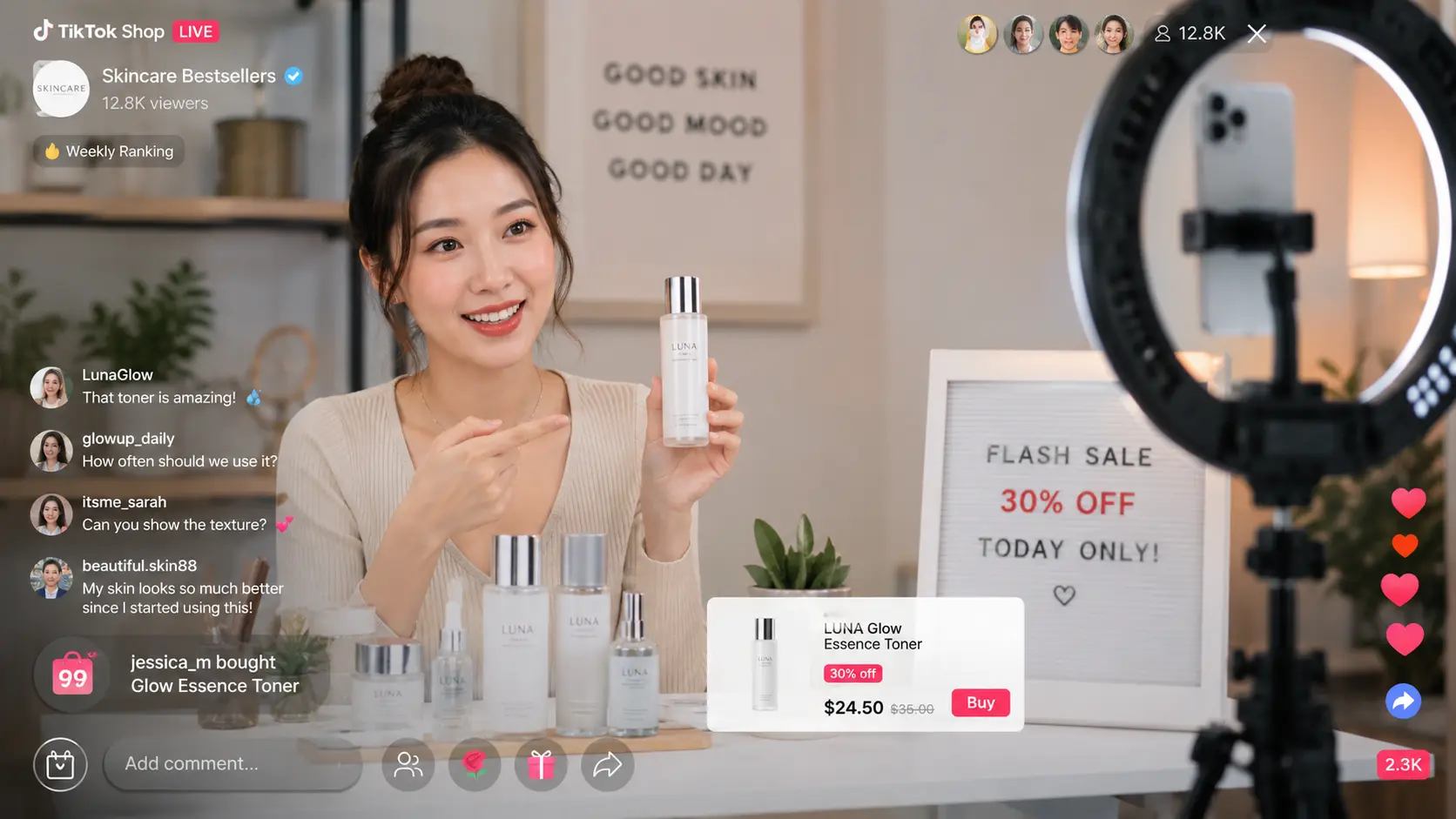
Live commerce represents a high-density conversion channel that combines real-time product demonstration with instant buyer Q&A. Executing dedicated 2-to-4-hour live shopping events generates immediate sales spikes, creates visual urgency through real-time flash deals, and drives significant organic feed distribution.
The Retail Halo Effect
TikTok Shop momentum regularly lifts conversion performance across external sales channels. Brands that maintain multi-channel attribution tracking routinely observe significant indirect performance lifts following TikTok Shop campaigns:
- Direct-to-Consumer (DTC) Lift: Increased branded search volume and direct website checkouts driven by non-clicking TikTok viewers.
- Marketplace Optimization: Higher Best Sellers Rank (BSR) and organic search conversions on Amazon UK/US as prospective buyers cross-reference reviews.
- Brick-and-Mortar Retail Velocity: Stronger physical store sell-through driven by local brand awareness generated on social feeds.
Attributing campaign results exclusively to in-app TikTok Shop transactions underestimates the full multi-channel business impact of your marketing spend.
Conclusion
Scaling a brand on TikTok Shop follows a structured operational arc: a cold start signal window (Months 1–3) where algorithms index your product and buyer demographic, a growth phase (Months 3–6) where repeatable creative signals emerge, and an advanced scale phase where validated paid tactics, live commerce, and multi-channel halo effects compound results. Winning brands treat the early months as an investment in presence, infrastructure, and algorithmic signal rather than expecting instant top-line margins.
Granular financial planning serves as the operational backbone of this growth framework. A forecasted P&L model that accounts for media spend, creator payouts, landed COGS, platform fees, and return allowances protects gross margins as volume expands. Paired with a creative-first UGC content engine and cross-platform asset syndication, brands maintain continuous feed relevance across their full marketing mix.
RGC Mkt specializes in full-funnel TikTok Shop management and social commerce growth strategy for product-based brands. From initial TikTok Shop setup, catalog configuration, and Product Listing Optimization (PLO) to TikTok Ads management (including GMV Max and Spark Ads execution), creator affiliate outreach, and multi-channel campaign planning, RGC Mkt provides the strategic framework and technical infrastructure required to scale predictably. Reach out to the RGC Mkt team today to evaluate your current setup and launch your next growth phase.