

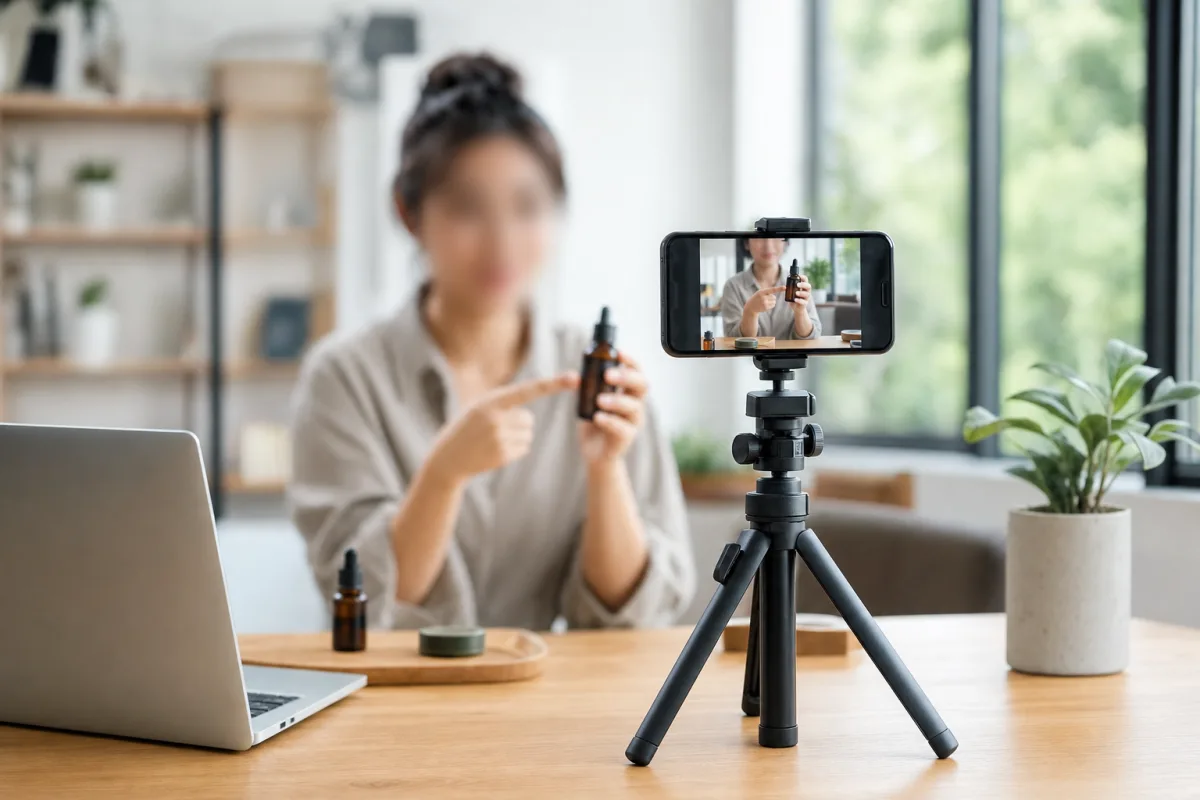
TikTok Shop affiliate has become one of the most accessible ways for creators to earn money without managing products, inventory or customer support. The model is simple: you promote products listed on TikTok Shop, your audience buys through your affiliate link, and you collect a commission on every sale.
What makes this opportunity compelling is the combination of organic reach and built-in purchase intent. When a short video goes viral on TikTok, it can generate hundreds of sales within hours. The challenge is building a repeatable system around that potential, one that works even before you have a massive following.
This guide walks through the full process, from understanding the affiliate mechanics to selecting products, creating content that converts, and scaling what works.
What is TikTok Shop affiliate and how it works
TikTok Shop affiliate is a performance-based model where creators earn a commission each time someone purchases a product through their unique affiliate link. You are not selling your own product. You are connecting an existing product with an audience that is already watching your content, and you get paid when that connection results in a transaction.
The mechanics are straightforward. A brand or seller lists a product on TikTok Shop and sets a commission rate for affiliates. Creators browse the available products, request to collaborate, and once approved, receive an affiliate link or product tag to include in their videos. When a viewer clicks the tag and completes a purchase, the commission is tracked automatically.
Commission rates typically range from 10% to 20%, depending on the product and seller. To understand what that means in practice, consider a $40 product at a 20% commission rate: each sale generates $8 for the creator. If a video reaches 10,000 views and converts at a 1% rate, that equals roughly 100 sales and $800 in affiliate revenue from a single post. These are illustrative numbers, but they show how quickly results can compound when the product and content align. A single well-executed short video can generate significant commissions without any ongoing effort after the post goes live.
The low friction of the model is one of its biggest advantages. Affiliates have no responsibility for fulfillment, returns or customer service. The seller handles all of that. Your only job is to create content that makes the right audience want to buy.
Eligibility, account setup and quick-start options
Before you can promote products as a TikTok Shop affiliate, your account needs to meet the platform’s baseline requirements. The standard eligibility criteria include being at least 18 years old, having a minimum of 5,000 followers, and maintaining compliance with TikTok’s community guidelines. Your account must be in good standing with no active violations.
If you are below the follower threshold, the fastest legitimate path is to focus on consistent, niche-specific content to grow your audience organically before applying. Partnering with an already-eligible creator is another option: you help source or develop the product angle, and they handle promotion while you build your own following in parallel. This approach keeps you within platform rules and avoids the significant risks associated with third-party account acquisition, which can result in permanent bans and financial losses.
Once you meet the requirements, setup is straightforward. Apply through the TikTok Shop affiliate portal, connect your account, and browse the product marketplace to find items you want to promote. You can add affiliate product links directly to your video posts or bio, and the platform tracks clicks and conversions automatically.
Pay close attention to community guidelines throughout the process. TikTok actively enforces content standards, and misleading product claims or policy violations can result in account restrictions that cut off your affiliate access entirely.
How to find winning products (selection criteria and filters)
Product selection is where most TikTok Shop affiliates succeed or fail. A well-crafted video promoting a weak product will underperform every time. Before you create a single frame of content, you need to know the product is worth promoting.
Every strong affiliate product should pass three core tests. First, it needs to solve a specific, visible problem. Products that fix a pain point are easy to demonstrate and easy to sell. Second, it needs viral potential, meaning the product is visually interesting, surprising, or produces a clear before-and-after result that translates well to short video. Third, it needs mass appeal: the problem it solves should resonate with a broad audience, not a narrow niche.
Beyond those qualitative filters, use specific numeric criteria to narrow your search:
- Commission rate: target products offering 15–20%
- Price point: prefer items priced at $100 or less to encourage impulse purchases
- Recent demand: look for products with at least 1,000 units sold in the past 30 days
- Ratings: prioritize products with strong customer reviews
- Avoid saturation: products with extremely high historical sales (think 100,000+ units) are likely oversaturated and difficult to penetrate with organic content
Product-research platforms built for TikTok Shop can accelerate this process significantly. Most allow you to filter by commission rate, price, sales volume and content strategy. Using the video e-commerce filter within these tools helps surface products that are already performing well in short-form content, which gives you a clearer picture of what formats and angles are working before you invest time creating your own videos.
Creating viral short-form content that converts
Choosing the right product gets you to the starting line. The content you create determines whether you cross it. TikTok rewards videos that hold attention, and affiliate videos need to do something more specific: they need to hold attention and create enough buying intent that the viewer taps the product link before the impulse fades.
Every high-converting affiliate video follows a similar structure. The first one to three seconds must contain a hook that immediately signals relevance. Show the problem before you show the product. Viewers need to recognize themselves in the scenario before they care about the solution. The product demonstration should be short, clear and focused on a single benefit rather than listing every feature. Close with a direct, simple call-to-action that tells the viewer exactly where to find the product.
Formats that consistently perform well include quick product demos, before-and-after reveals, reaction clips showing a first-time use, and single-benefit highlight reels that make one strong point in under 15 seconds. The common thread is clarity. A 6-second demo that makes one benefit impossible to miss will often outperform a polished 60-second video that tries to explain everything.
Never rely on a single video. Create at least three different variations for each product, testing different hooks, angles or formats. Track view-to-click rate and click-to-conversion rate for each. The video that drives the most conversions, not just the most views, is the one worth scaling. Always follow TikTok’s content policies in product demonstrations and avoid any claims you cannot accurately substantiate.
Scaling, tools and optimization for consistent commissions
Finding one video that converts is a result. Building a system that produces converting videos consistently is a business. The shift from one to the other requires treating your top performers as data points, not just wins.
When a video performs well, analyze what made it work. Was it the hook format? The product angle? The video length? Replicate those variables with similar products in the same category before you try to apply them across unrelated niches. Expanding horizontally within a product type is lower risk than jumping to a completely different category before you understand why a format worked.
Paid distribution is one of the most efficient ways to extend a winning creative’s reach. Start with a small test budget on your best-performing organic video to validate whether it holds its conversion rate under paid traffic. If it does, scaling the budget becomes a more calculated decision rather than a gamble. Be conservative with initial ad spend and set clear cost-per-acquisition targets before increasing investment.
Optimization also applies to the product side. Work with sellers to improve product descriptions, pricing clarity and listing quality, all of which affect conversion after the click. Creator partnerships, where you collaborate with other eligible creators to cross-promote strong products, can multiply reach without requiring proportional increases in your own content output. Use platform analytics to track which products and content formats generate the highest return, and adjust your cadence and focus accordingly.
Conclusion
The core of a profitable TikTok Shop affiliate approach comes down to three decisions made well: choosing products that solve real problems and trigger impulse purchases, creating short-form content with a clear hook and a focused call-to-action, and using conversion data to scale what actually works. None of these steps require a large following or a big budget to start, but all of them require deliberate execution.
For product-based businesses and brands looking to grow through TikTok Shop and social commerce, the affiliate channel is one piece of a larger strategy that includes shop setup, product listing optimization, marketplace management, content management, creator outreach, campaign planning and TikTok Ads management. RGC Mkt specializes in this full ecosystem, helping brands build and scale their presence across TikTok Shop and connected commerce channels with the right mix of organic content, creator partnerships and paid advertising.
As a practical next step, audit your current product mix against the selection filters covered in this guide, test at least three short-form video concepts on your strongest product, and track conversions rather than just views. If you want support building or scaling your TikTok Shop affiliate strategy, reach out to the RGC Mkt team and let’s map out the right approach for your business.